The Seven Sorrows Rosary offers a profound devotional practice, centering on Mary’s immense suffering alongside Christ’s Passion;
This unique rosary, gaining renewed attention through modern apparitions, invites Catholics to deeply contemplate the Virgin Mary’s pain.
Historically, devotion to the Seven Sorrows grew alongside the traditional fifteen mysteries, providing a distinct pathway for spiritual reflection and empathy.
Historical Background of the Rosary
The Rosary’s origins trace back to the early centuries of Christianity, evolving from the practice of reciting the Psalms. Initially, lay people, unable to read the entirety of the Psalms, substituted them with the Lord’s Prayer, recited 150 times – mirroring the 150 Psalms.
Over time, this practice became associated with meditating on specific events in the lives of Jesus and Mary. The formal structure of the Rosary, as we know it today, developed gradually throughout the Middle Ages, largely attributed to Saint Dominic in the 13th century.
While the traditional Rosary focuses on the Joyful, Sorrowful, Glorious, and Luminous Mysteries, the Seven Sorrows Rosary emerged as a distinct devotion, emphasizing Mary’s profound grief. Its resurgence in recent decades, particularly linked to the apparitions at Kibeho, highlights a renewed interest in this powerful form of Marian prayer.
The Significance of Marian Devotion
Marian devotion holds a central place within Catholic theology, rooted in the belief that Mary, as the Mother of God, occupies a unique position in salvation history. Honoring Mary isn’t worship, but rather a profound veneration acknowledging her role in God’s plan and her intercession on behalf of humanity.
The Seven Sorrows Rosary specifically taps into the profound empathy for Mary’s suffering, recognizing her co-redemptive role alongside Christ. Contemplating her sorrows isn’t morbid, but a pathway to deeper understanding of Christ’s sacrifice and the cost of redemption.
This devotion fosters a closer relationship with Mary, inviting her maternal guidance and strength. Through shared sorrow, believers find spiritual comfort and healing, mirroring Mary’s unwavering faith amidst unimaginable pain. It’s a powerful expression of love and gratitude for the Mother of God.

The Seven Sorrows: A Detailed Examination
Each sorrow—Simeon’s prophecy, the flight into Egypt, losing Jesus at the Temple, meeting Him on Calvary, the Crucifixion, taking down His body, and burial—evokes deep contemplation.
The Prophecy of Simeon
The first sorrow centers on the poignant prophecy delivered by Simeon in the Temple, as recounted in the Gospel of Luke. Upon meeting the infant Jesus, Simeon foretold the child’s destiny as a light for revelation to the Gentiles and the glory of Israel, but also a sign of contradiction.
He prophetically declared that a sword would pierce Mary’s own heart, foreshadowing the immense suffering she would endure as the mother of the Savior. This moment, while filled with initial joy at Jesus’ presentation, was overshadowed by the weight of Simeon’s words, marking the beginning of Mary’s journey of sorrow.
Contemplating this sorrow within the Seven Sorrows Rosary invites reflection on the acceptance of God’s will, even when it entails profound pain, and the understanding of Mary’s unwavering faith in the face of future hardship.
The Flight into Egypt
The second sorrow recalls the Holy Family’s desperate flight into Egypt to escape the murderous decree of King Herod. Warned in a dream, Joseph, Mary, and the infant Jesus were forced to abandon their home and embark on a perilous journey to a foreign land, seeking refuge from persecution.
This sorrow highlights the vulnerability of the Holy Family, the hardship of their exile, and the constant threat they faced. Mary, as a mother, endured the anxiety of protecting her child in unfamiliar and potentially hostile surroundings. The flight represents a disruption of their peaceful life and a foreshadowing of the suffering to come.
Praying this sorrow within the Seven Sorrows Rosary encourages empathy for refugees and those displaced by violence, and a recognition of the sacrifices made for the sake of preserving life.
The Loss of Jesus at the Temple
The third sorrow centers on the agonizing experience of Mary and Joseph losing the twelve-year-old Jesus in the Temple in Jerusalem. During a pilgrimage for Passover, they assumed Jesus was traveling with relatives, only to discover, after a day’s journey, that He was missing. This sparked three days of frantic searching and immense emotional distress for Mary.
This sorrow reveals Mary’s profound maternal anguish and the piercing pain of separation from her beloved Son. It wasn’t merely a physical loss, but a foreshadowing of the ultimate separation at the Crucifixion. The experience underscores the hidden life of Jesus and Mary’s unwavering faith amidst uncertainty.
Reflecting on this sorrow within the Rosary invites us to understand Mary’s heart and to seek Jesus diligently in our own lives.

Meeting Jesus on the Way to Calvary
The fifth sorrow depicts the heart-wrenching encounter of Mary with her Son, Jesus, as He carried His cross along the Via Dolorosa to Calvary. Despite the immense crowd and the brutality of the Roman soldiers, Mary bravely pushed through to be near Him during His agonizing journey.
This sorrow isn’t simply witnessing physical suffering; it’s experiencing the profound emotional and spiritual weight of Jesus’s sacrifice. Mary’s presence embodies unwavering love and solidarity with her Son in His most vulnerable moment. It’s a testament to her courage and maternal devotion.
Meditating on this sorrow within the Rosary invites us to share in Mary’s compassion and to offer our own suffering alongside Jesus’s.
The Crucifixion of Jesus
The sixth sorrow focuses on the unimaginable agony of Mary witnessing the crucifixion of her beloved Son, Jesus Christ. Standing at the foot of the cross, she endured the ultimate maternal pain – observing His suffering, humiliation, and eventual death. This sorrow represents the culmination of all her previous griefs, a piercing wound to her heart.
The crucifixion wasn’t merely a physical execution; it was a spiritual assault on innocence and goodness. Mary’s presence signifies her unwavering faith and her complete union with Jesus’s sacrifice. She embodies the sorrowful mother, offering her pain for the salvation of humanity.
Contemplating this sorrow within the Rosary calls us to recognize the depth of Jesus’s love and the cost of our redemption.
Taking Down the Body of Jesus
The seventh and final sorrow depicts the heartbreaking moment when Mary receives the lifeless body of her Son, Jesus, after His crucifixion. This act of taking down the body, traditionally performed by Joseph of Arimathea and Nicodemus, is profoundly sorrowful for Mary, representing the finality of His earthly suffering.
Holding her Son’s broken body, she experiences a grief beyond comprehension – a mother’s ultimate loss. This sorrow isn’t simply about death; it’s about the extinguishing of life, hope, and the visible presence of God’s Son in the world. It’s a moment of utter desolation.
Reflecting on this sorrow within the Rosary invites us to share in Mary’s grief and to contemplate the immense sacrifice made for our salvation.
The Burial of Jesus
The final sorrow of the Seven Sorrows Rosary focuses on the burial of Jesus, a moment filled with both finality and a glimmer of hope. Mary witnesses the placement of her Son’s body in the tomb, a stark and desolate scene signifying the completion of His earthly mission and the apparent triumph of death.
This sorrow isn’t merely about the physical act of burial; it represents the extinguishing of all visible signs of Jesus’ presence. Mary’s heart is pierced with the knowledge of His suffering and the uncertainty of what lies ahead. Yet, within this darkness, faith whispers of resurrection.
Contemplating this sorrow invites us to embrace the mystery of death and resurrection, and to trust in God’s ultimate plan for salvation.
The Seven Sorrows Rosary: Structure and Prayers
This rosary uniquely sequences prayers through the seven sorrows, utilizing familiar elements like the Our Father and Hail Mary, but focused on Mary’s grief.
The Rosary’s Unique Sequence
Unlike the traditional fifteen or twenty mysteries rosary, the Seven Sorrows Rosary follows the seven distinct sorrows experienced by Mary throughout Jesus’ life. Each sorrow—the Prophecy of Simeon, the Flight into Egypt, the Loss at the Temple, Meeting on the Way to Calvary, the Crucifixion, Taking Down the Body, and the Burial—forms a specific section for meditation.
The sequence isn’t simply a linear progression; it’s a deeply emotional journey. Each sorrow is contemplated through a set number of Hail Marys, Our Fathers, and Glory Bes, encouraging a focused and empathetic prayer experience. This structure allows for a more concentrated reflection on Mary’s suffering and her unwavering faith.
PDF versions of the rosary often visually represent this sequence, guiding the user through each sorrow with accompanying imagery and prayers, enhancing the devotional practice.
Prayers Associated with Each Sorrow
Each of the Seven Sorrows is traditionally accompanied by specific prayers designed to deepen contemplation of Mary’s pain and her unwavering faith. Beyond the standard Hail Mary, Our Father, and Glory Be, many Seven Sorrows Rosary PDFs include a memorial prayer specific to each sorrow.
These memorial prayers often focus on the emotional and spiritual weight of the event, inviting the pray-er to enter into Mary’s perspective. For example, the prayer for the Crucifixion might emphasize her agonizing witness to her Son’s suffering.
PDF resources frequently provide these sorrow-specific prayers alongside the standard rosary prayers, creating a more immersive and emotionally resonant devotional experience. The inclusion of these prayers elevates the practice beyond rote recitation, fostering a deeper connection with Mary’s heart.
Differences from the Traditional Rosary
The Seven Sorrows Rosary diverges from the traditional fifteen-mystery Rosary primarily in its focus and sequence. Instead of meditating on the Joyful, Sorrowful, and Glorious Mysteries, it centers solely on the seven sorrows of Mary, offering a concentrated contemplation of her suffering.
PDF guides for the Seven Sorrows Rosary typically present the sorrows in chronological order – from the Prophecy of Simeon to the Burial of Jesus – guiding the pray-er through a narrative of Mary’s grief.
While the basic structure of decades and prayers remains similar, the thematic emphasis shifts dramatically. This rosary isn’t about celebrating joyful events, but about entering into Mary’s heart and sharing her sorrow, fostering profound empathy and spiritual healing.
Finding a Seven Sorrows Rosary PDF
Numerous online resources offer downloadable Seven Sorrows Rosary PDFs, readily available on Catholic websites and devotional platforms for convenient prayer and reflection.
Online Resources for Downloadable PDFs
A wealth of digital resources provides easy access to Seven Sorrows Rosary PDFs. Websites dedicated to Catholic devotionals frequently host these materials, offering various formats to suit different preferences. Searching online using keywords like “Seven Sorrows Rosary PDF,” “Dolorosa Rosary PDF,” or “Chaplet of the Seven Sorrows PDF” yields numerous results.
Several online stores specializing in religious articles also provide downloadable PDFs as a complimentary resource with purchase or as a standalone offering. Additionally, many traditional Catholic websites and forums dedicated to Marian devotion often have sections where members share downloadable prayer guides, including the Seven Sorrows Rosary. These resources often include the prayers associated with each sorrow, along with instructions on how to pray the rosary correctly.
Before downloading, it’s advisable to ensure the source is reputable and aligned with Catholic teachings to guarantee the accuracy and authenticity of the prayers and devotions presented.
Availability on Catholic Websites
Numerous Catholic websites offer the Seven Sorrows Rosary PDF for free download, reflecting a growing interest in this devotional practice. Diocesan websites, parish resources, and organizations dedicated to Marian devotion frequently provide these materials. Sites like those affiliated with religious orders, such as the Servites (historically linked to the devotion), are excellent starting points.
Many Catholic publishers also host downloadable PDFs on their websites as promotional materials or free resources for their customers. Look for sections dedicated to prayer guides, devotionals, or rosaries. These PDFs often include detailed explanations of the Seven Sorrows, along with the corresponding prayers for each mystery.
Ensure the website is officially recognized by the Catholic Church or a reputable Catholic organization to verify the theological soundness of the content before downloading and using the PDF.
Printing Considerations for PDF Rosaries
When printing a Seven Sorrows Rosary PDF, consider paper quality for durability; cardstock is preferable to standard printer paper. Ensure your printer settings are optimized for the best visual representation of the images and text, selecting a high-resolution print option. Double-sided printing conserves paper and creates a booklet-style rosary guide.
Before printing the entire document, print a test page to verify the layout and ensure all elements align correctly. Pay attention to margins – sufficient space is needed for comfortable reading and potential hole-punching if you intend to bind the pages.
Laminating the printed pages offers added protection against wear and tear, making the rosary guide more resilient for frequent use during personal or group prayer.
The Rosary in Modern Marian Apparitions
Modern apparitions, notably in Kibeho and through Immaculée Ilibagiza, have emphasized the Seven Sorrows Rosary, urging its revival as a powerful prayer tool.
Kibeho Apparitions and the Seven Sorrows Rosary
The Kibeho apparitions, recognized by the Catholic Church, significantly revived devotion to the Seven Sorrows Rosary. In the late 1980s, the Virgin Mary reportedly appeared to Rwandan schoolgirls, consistently requesting the recitation of this specific rosary. She emphasized its power in combating evil and fostering peace, particularly amidst growing societal unrest.
The visionaries stressed that Our Lady didn’t simply recommend the rosary, but actively asked for it, highlighting its unique importance. This direct request spurred increased interest and dissemination of the Seven Sorrows Rosary within Rwanda and beyond. Many believe the apparitions served as a prophetic warning, and the rosary was presented as a spiritual weapon against the impending genocide.
Consequently, downloadable Seven Sorrows Rosary PDFs became increasingly sought after, allowing faithful individuals to easily access and practice this powerful devotion as requested by the Blessed Virgin Mary in Kibeho.
Immaculée Ilibagiza and the Rosary’s Role
Immaculée Ilibagiza, a Rwandan genocide survivor, powerfully illustrates the Seven Sorrows Rosary’s protective and consoling power. Hiding for 91 days during the 1994 genocide, Immaculée clung to her rosary – specifically, the Seven Sorrows Rosary – as her lifeline to God and source of strength. She credits the rosary with her survival, both physically and spiritually.
Her harrowing story, detailed in her book “Left to Tell,” emphasizes how the contemplation of Mary’s sorrows offered her solace amidst unimaginable suffering. The rosary became a constant companion, a means of uniting her pain with Christ’s Passion and Mary’s grief.
Immaculée’s testimony has inspired countless individuals to embrace this devotion, leading to a surge in demand for Seven Sorrows Rosary PDFs and resources. Her experience demonstrates the rosary’s ability to provide profound comfort and unwavering faith during times of immense hardship.
Benefits of Praying the Seven Sorrows Rosary
Praying this rosary cultivates spiritual comfort, deepens empathy for Mary’s suffering, and strengthens your relationship with Christ through shared sorrow and devotion.
Spiritual Comfort and Healing
The Seven Sorrows Rosary provides profound spiritual solace during times of personal hardship and grief. Contemplating Mary’s sorrows, borne with unwavering faith, offers a powerful example of strength and resilience in the face of immense suffering.
This devotion isn’t merely about acknowledging pain; it’s about finding comfort within that pain, recognizing a shared human experience of loss and sorrow. Many find that meditating on each sorrow—from the prophecy of Simeon to the burial of Jesus—allows for a release of pent-up emotions and a sense of peace.
Furthermore, the rosary’s repetitive prayers and rhythmic nature can be incredibly soothing, acting as a meditative practice that quiets the mind and opens the heart to divine grace. It’s a pathway to healing, not by eliminating sorrow, but by transforming it through faith and acceptance.
Increased Empathy for Mary’s Suffering
Praying the Seven Sorrows Rosary cultivates a deeper, more intimate understanding of Mary’s profound grief throughout Christ’s life. It moves beyond a simple intellectual acknowledgement of her pain to an emotional resonance with her experience. By deliberately focusing on each sorrow – the prophecy, the flight, the loss in the Temple, and so on – the rosary invites us to truly feel with Mary.
This empathetic connection isn’t about pity, but about solidarity. It’s recognizing her as a mother whose heart was pierced, a witness to unimaginable suffering. This heightened empathy fosters a greater appreciation for her role in salvation history and her unwavering faithfulness.
Through this devotion, we are challenged to consider our own sorrows in light of hers, finding strength and hope in her example of enduring faith amidst heartbreak.
Deepening Relationship with Christ
The Seven Sorrows Rosary, while focused on Mary’s pain, ultimately serves to draw the faithful closer to Christ. Contemplating her suffering alongside His Passion intensifies our understanding of the sacrifice He willingly endured for humanity’s salvation. It’s through Mary’s eyes that we witness the full weight of Christ’s love and the depth of His suffering.
By meditating on each sorrow, we are invited to enter more fully into the mysteries of the Gospel, recognizing the profound connection between mother and Son. This shared experience of sorrow fosters a more intimate and personal relationship with Jesus.
The rosary isn’t merely a recounting of events; it’s an invitation to participate in the redemptive drama of Christ’s life, death, and resurrection, guided by Mary’s unwavering presence.
Cultural Representations of Our Lady of Sorrows
Our Lady of Sorrows is powerfully depicted in art, notably at Granada’s Basilica, and through feast day traditions, reflecting deep Marian devotion and sorrowful contemplation.
Artistic Depictions in Paintings and Sculptures
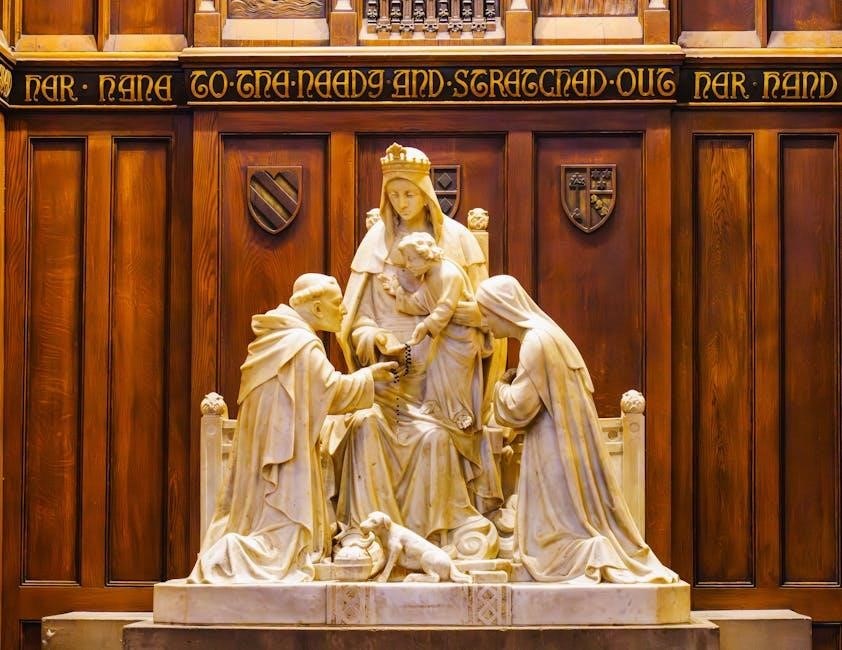
Throughout art history, Our Lady of Sorrows has been a compelling subject, inspiring countless paintings and sculptures that vividly portray her profound grief. These artistic representations commonly feature Mary with a pierced heart, symbolizing her immense suffering during Christ’s Passion and her participation in his sacrifice.
Artists often depict the seven sorrows themselves – the Prophecy of Simeon, the Flight into Egypt, the Loss at the Temple, the Meeting on the Way to Calvary, the Crucifixion, Taking Down the Body, and the Burial – as individual scenes or incorporated into larger compositions. The imagery aims to evoke empathy and encourage viewers to contemplate Mary’s pain.
Sculptures frequently show Mary draped in dark garments, her face etched with sorrow, and her hands clasped in prayer. These visual cues emphasize her role as a compassionate mother and a model of faith in the face of unimaginable loss. The artistic legacy continues to inspire devotion and reflection on the Seven Sorrows today.
The Basilica of Our Lady of Sorrows in Granada, Spain
The Basilica of Our Lady of Sorrows in Granada, Spain, stands as a significant pilgrimage site dedicated to the Virgin Mary and her seven sorrows. This stunning church, built in the 16th century, showcases a blend of Gothic and Renaissance architectural styles, reflecting the rich history of the region.
Within the basilica, visitors can admire intricate artwork and devotional objects centered around the theme of Mary’s suffering. The main chapel houses a revered image of Our Lady of Sorrows, attracting devotees seeking solace and spiritual guidance. The basilica serves as a powerful reminder of Mary’s compassion and her role in salvation history.
Pilgrims often visit to pray the Seven Sorrows Rosary, finding inspiration in the basilica’s serene atmosphere and artistic beauty. It’s a place of deep faith and contemplation, honoring the profound sorrow and unwavering love of the Blessed Virgin Mary.
Feast Day Observances and Traditions
The Feast of Our Lady of Sorrows, observed annually on September 15th, is a day dedicated to honoring the seven sorrows of Mary. Catholic traditions surrounding this feast emphasize solemn remembrance and heartfelt devotion. Many parishes hold special Masses and prayer services focused on Mary’s suffering alongside Christ.
Devotees often participate in praying the Seven Sorrows Rosary, reflecting on each sorrow individually and meditating on Mary’s profound grief. It’s customary to wear blue, Mary’s traditional color, as a sign of respect and solidarity. Some families create small home altars adorned with images of Our Lady of Sorrows and flowers.
Traditional practices also include acts of penance and sacrifice, offered in union with Mary’s pain. The feast serves as a poignant reminder of the cost of redemption and the unwavering faith of the Blessed Virgin Mary.