
Canon 7D Mark II Manual: A Comprehensive Guide
Welcome! This guide unlocks your Canon 7D Mark II’s potential, offering detailed instructions for both beginners and experienced photographers, starting today, 04/01/2026.
Embark on a photographic journey with the Canon 7D Mark II, a powerhouse designed for enthusiasts and professionals alike. This DSLR boasts a 20.2MP Full-Frame CMOS sensor and Dual Pixel CMOS AF, delivering exceptional image quality and responsiveness.
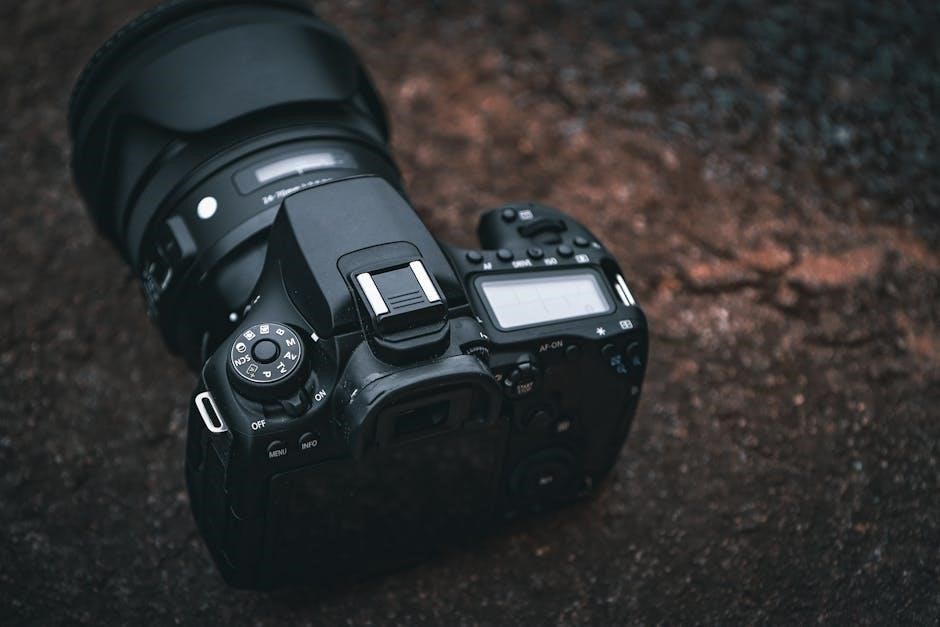
This manual serves as your comprehensive companion, guiding you through every feature, from initial setup to advanced shooting techniques. We’ll explore its robust build, intuitive controls, and versatile capabilities, ensuring you maximize its potential. Today, 04/01/2026, begin mastering your camera!
Unboxing and Initial Setup
Carefully unpack your Canon 7D Mark II, verifying all included accessories: camera body, battery, battery charger, strap, and manuals. Insert the battery and format a compatible SD card. Connect the camera to a computer via USB to charge the battery fully – crucial for optimal performance.
Set the date, time, and shooting preferences via the menu. Today, 04/01/2026, familiarize yourself with attaching and detaching lenses. Ensure a secure connection before powering on. Initial setup is key to a smooth photographic experience!
Understanding the Camera Body & Controls
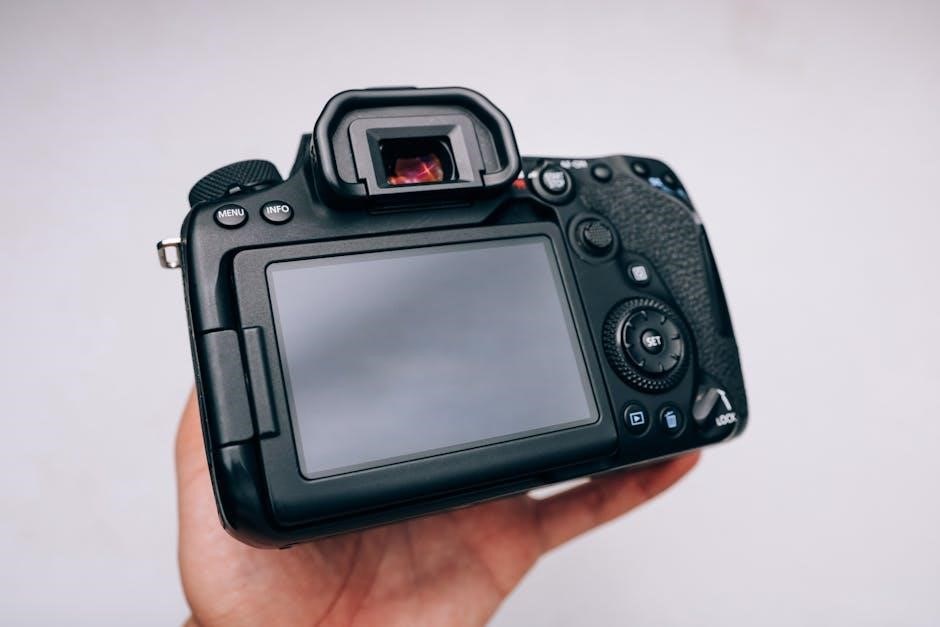
The Canon 7D Mark II boasts a robust, weather-sealed body designed for demanding conditions. Locate the power switch, shutter button, mode dial, and control dials. The rear panel houses the LCD screen, directional buttons, and menu access.

Familiarize yourself with the Quick Control dial for swift setting adjustments. Today, 04/01/2026, understanding the physical layout is paramount. Explore the grip for comfortable handling and identify key button placements for efficient operation during shooting sessions.
Button and Dial Functions
The Main Dial adjusts settings like aperture and shutter speed, while the Quick Control Dial offers rapid access to frequently used functions. The AF-ON button initiates autofocus independently of the shutter.
The SET button confirms selections, and directional buttons navigate menus. Today, 04/01/2026, the joystick enables precise AF point selection. Mastering these controls enhances shooting speed and customization, allowing for intuitive operation in diverse photographic scenarios.
Customizing Control Layouts
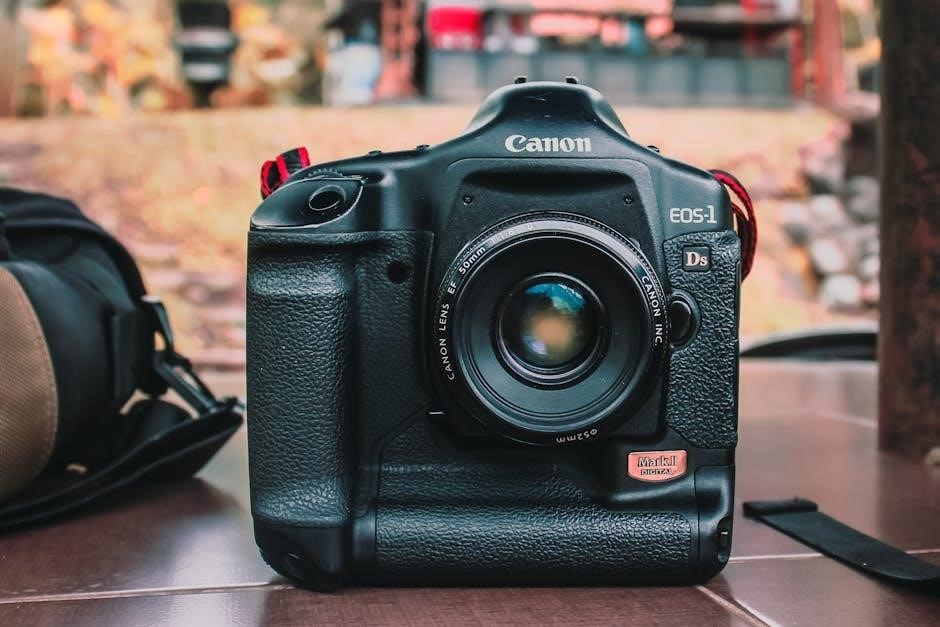
Personalize your 7D Mark II! Canon allows reassigning button and dial functions via the Custom Functions menu. Tailor controls to your shooting style for efficient operation. Today, 04/01/2026, you can assign frequently used settings to the AF-ON button or depth-of-field preview button.
Create a layout that perfectly matches your workflow, improving responsiveness and reducing time spent navigating menus. Experiment to discover the most comfortable and productive configuration for your needs.
Navigating the Menu System
Mastering the menus is key! The Canon 7D Mark II features a comprehensive menu system, organized into several tabs for easy access. Today, 04/01/2026, explore the Shooting, AF, Setup, and Custom Function menus. Use the directional buttons and SET button to navigate and select options.
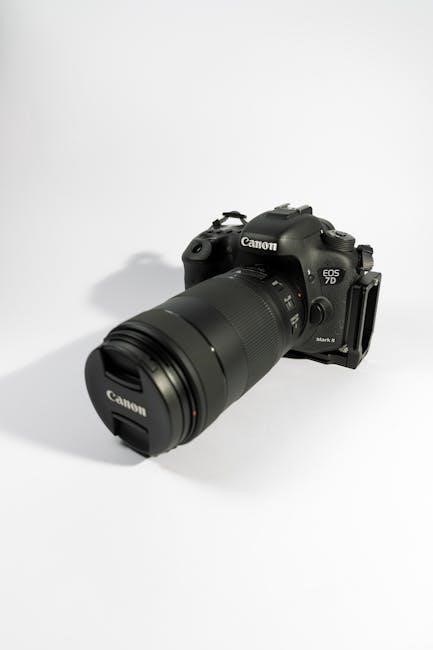
Understanding the menu structure allows quick adjustments to camera settings. Don’t hesitate to explore each section to unlock the full potential of your camera and personalize your shooting experience.
Shooting Menu Options
Dive into shooting settings! Within the Shooting Menu, you’ll find crucial options like image quality (RAW/JPEG), picture style, and auto lighting optimizer. Today, 04/01/2026, adjust settings for burst shooting, self-timer, and remote control operation.
Explore options for metering mode, white balance, and ISO speed. Customizing these settings allows precise control over your images. Familiarize yourself with each option to achieve desired results in various shooting scenarios.
Custom Function Settings
Personalize your 7D Mark II! The Custom Function menu, accessible today, 04/01/2026, allows tailoring the camera to your shooting style. Assign functions to buttons and dials for quicker access to frequently used settings.
Customize autofocus behavior, metering modes, and display options. Create up to three user-defined shooting presets for instant recall. This menu is key to streamlining your workflow and maximizing efficiency in the field, enhancing your photographic experience.
Focusing System: A Deep Dive
Master precise focusing! The Canon 7D Mark II boasts a sophisticated 65-point all cross-type autofocus system, effective today, 04/01/2026. Explore various AF area selection modes – Single-Point, Zone, and Large Zone – for diverse subjects.
Understand AF point expansion and tracking sensitivity for dynamic subject acquisition. Dive into AI Servo AF for continuous focusing on moving targets. This section details achieving sharp images consistently, regardless of the shooting scenario.
Autofocus Modes Explained
Unlock AF precision! One-Shot AF is ideal for stationary subjects, locking focus upon half-pressing the shutter, effective today, 04/01/2026. AI Servo AF continuously tracks moving subjects, adjusting focus as they change position.
AI Focus AF intelligently switches between One-Shot and AI Servo. Explore AF point selection methods: automatic selection, spot AF, and manual point selection. Understanding these modes ensures consistently sharp results, tailored to your photographic needs and subject matter.
Manual Focus Techniques
Take control! Engage manual focus via the AF/MF switch on the rear of the camera, effective today, 04/01/2026. Utilize Live View with magnification for precise focusing on challenging subjects.
Employ focus peaking, highlighting in-focus areas, for enhanced accuracy. Practice smooth focusing ring adjustments for cinematic effects. Remember, manual focus excels in low light or when autofocus struggles with complex scenes, granting ultimate creative control.
Image Quality Settings & RAW vs. JPEG
Maximize potential! Access image quality settings within the menu, effective today, 04/01/2026. Choose RAW for maximum editing flexibility, capturing all sensor data.
JPEG offers smaller file sizes and convenience, ideal for immediate sharing. Consider RAW+JPEG for a balance of both worlds. Higher quality settings yield larger files but superior detail. Understand these trade-offs to optimize your workflow and achieve desired results.
Shooting Modes: Choosing the Right One
Explore versatility! The Canon 7D Mark II offers diverse shooting modes, effective today, 04/01/2026. Program (P) provides automatic settings with some user control.
Aperture Priority (Av) lets you set the aperture, influencing depth of field. Shutter Priority (Tv) controls shutter speed, freezing or blurring motion. Manual (M) grants full control over both. Select the mode matching your creative vision and shooting conditions for optimal results.
Aperture Priority (Av) Mode
Master depth of field! In Av mode, available today, 04/01/2026, you dictate the aperture (f-stop), controlling the area in focus. A wider aperture (lower f-number, like f/2;8) creates shallow depth, ideal for portraits with blurred backgrounds.
Conversely, a narrower aperture (higher f-number, like f/16) maximizes depth, perfect for landscapes. The camera automatically adjusts shutter speed for proper exposure, balancing aperture with light sensitivity.
Shutter Priority (Tv) Mode
Freeze or blur motion! Tv mode, accessible today, 04/01/2026, lets you set the shutter speed, controlling how long the sensor is exposed to light. Fast shutter speeds (like 1/1000s) freeze action, perfect for sports photography.
Slower shutter speeds (like 1 second) create motion blur, ideal for conveying movement or shooting in low light. The camera automatically selects the aperture to achieve correct exposure, balancing speed with light;
Manual (M) Mode
Total creative control! Today, 04/01/2026, embrace full control with Manual mode. You independently set both aperture and shutter speed, dictating depth of field and motion blur. This mode demands understanding of the exposure triangle – aperture, shutter speed, and ISO.
Use the camera’s light meter as a guide, adjusting settings until proper exposure is achieved. Manual mode is essential for challenging lighting conditions and achieving specific artistic visions.
Video Recording Capabilities
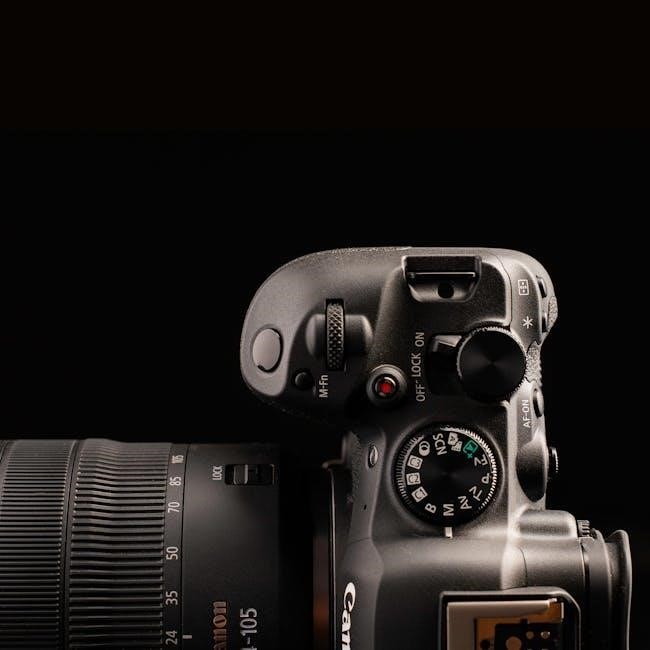
Capture cinematic footage! As of today, 04/01/2026, the 7D Mark II excels in video, recording Full HD 1080p at up to 60 frames per second for smooth, detailed motion. Choose frame rates based on your desired aesthetic – 24fps for a filmic look, 30fps for standard video, or 60fps for slow-motion potential.
Explore various recording options and external microphone compatibility for professional-quality audio.
Video Resolution and Frame Rates
Unlock video potential! The Canon 7D Mark II, as of 04/01/2026, records in Full HD 1920 x 1080 resolution, delivering sharp and detailed video. Frame rate options include 24p, 30p, and 60p for diverse creative control. 24p mimics a cinematic feel, 30p suits general use, and 60p enables smooth slow-motion effects.
Experiment with these settings to achieve your desired visual style and storytelling impact.
Audio Recording Options
Enhance your videos! The Canon 7D Mark II, current as of 04/01/2026, features a 3.5mm microphone input for external audio sources, vastly improving sound quality over the built-in microphone. Manual audio level control allows precise adjustment, preventing clipping or excessively quiet recordings.
Monitor audio levels via the headphone jack for real-time feedback. Consider an external recorder for professional-grade audio capture.
Understanding Metering Modes
Achieve perfect exposure! As of 04/01/2026, the Canon 7D Mark II offers three primary metering modes. Evaluative Metering analyzes the entire scene for balanced exposure – ideal for general use. Partial Metering assesses approximately 6.5% of the frame, useful for backlit subjects.
Spot Metering measures a very small area (2.8%) for precise control. Experiment to find the best mode for challenging lighting conditions and creative intent.
Evaluative Metering
The default, intelligent choice! As of 04/01/2026, Canon’s Evaluative Metering analyzes the entire scene using a 63-zone sensor. It considers brightness, color, and contrast to determine optimal exposure. This mode excels in diverse lighting, offering balanced results for most photographic situations.
It’s particularly effective for landscapes, portraits, and everyday photography, providing reliable and consistent exposures without extensive manual adjustments. Trust its smart assessment!
Partial Metering
Focused exposure control! Effective as of 04/01/2026, Partial Metering on the 7D Mark II measures light from approximately 6.5% of the frame’s center. This is ideal when your subject is strongly backlit or has significant contrast differences.
It allows for precise exposure control, preventing underexposure of the main subject. Use it when Evaluative Metering struggles, demanding a more targeted approach to achieve the desired results in challenging lighting scenarios.
Spot Metering
Pinpoint precision! As of 04/01/2026, Spot Metering on the Canon 7D Mark II measures light from an incredibly small 2.8% area of the frame, centered on the active focus point. This mode excels in extremely high-contrast situations, offering ultimate control.
It’s perfect for accurately exposing a specific detail within a scene, ignoring surrounding brightness. Mastering Spot Metering unlocks professional-level exposure accuracy, especially when dealing with tricky lighting conditions.
Working with White Balance
Achieve accurate colors! As of 04/01/2026, the Canon 7D Mark II offers robust White Balance control, crucial for natural-looking images. It corrects color casts caused by different light sources – sunlight, shade, tungsten, fluorescent, and flash.
Selecting the correct White Balance ensures whites appear white, and all other colors are rendered accurately. Explore preset options or create a custom balance for ultimate precision, enhancing your photographic vision.
Preset White Balance Settings
Quick color correction! As of 04/01/2026, the Canon 7D Mark II provides convenient preset White Balance options. These include Daylight, Cloudy, Shade, Tungsten, Fluorescent, and Flash. Each preset optimizes color temperature for specific lighting conditions, delivering accurate results instantly.
Experiment with presets to find the best match for your scene. While effective, remember custom White Balance offers greater control for truly precise color rendition, enhancing your images’ overall quality.
Custom White Balance Adjustment
Precise color control! As of 04/01/2026, for ultimate accuracy, the Canon 7D Mark II allows custom White Balance adjustment. Use a white or gray card under your current lighting. Navigate to the Custom White Balance setting in the menu, and follow the on-screen prompts to capture a reference image.
This ensures the camera accurately interprets colors, eliminating unwanted color casts. Mastering this technique unlocks professional-level color fidelity in your photographs, enhancing image realism.
Using Picture Styles
Tailor your images! As of 04/01/2026, Canon’s Picture Styles offer pre-set image processing parameters; Choose from Standard, Portrait, Landscape, Neutral, Faithful, and Monochrome. Each style adjusts sharpness, contrast, color saturation, and tone.
Customize these styles further to match your creative vision. You can even create and save your own unique Picture Styles for consistent results. Experiment to discover the perfect look for every shooting scenario!
Flash Photography with the 7D Mark II
Illuminate your scenes! As of 04/01/2026, the 7D Mark II features a built-in flash with various modes like Auto, Manual, and Red-Eye Reduction. Explore flash exposure compensation for precise control. The camera also supports external Speedlites for advanced lighting options.
Utilize High-Speed Sync (HSS) and E-TTL metering for professional results. Master flash synchronization with shutter speed to avoid dark bands and achieve creative effects. Experiment with off-camera flash setups!
Built-in Flash Features
Instant illumination! As of today, 04/01/2026, the Canon 7D Mark II’s integrated flash offers convenient on-camera lighting. It boasts a guide number of 19m at ISO 100, providing substantial power for various scenarios. Explore modes like Auto, Manual, and Red-Eye Reduction for tailored results.
Utilize flash exposure compensation to fine-tune brightness. The built-in flash also supports second-curtain sync, creating dramatic motion blur effects. Remember to consider bounce flash techniques for softer, more natural lighting!
External Flash Compatibility
Expand your lighting! As of today, 04/01/2026, the Canon 7D Mark II fully supports Canon’s Speedlite range, offering advanced flash control. It’s compatible with both standard and TTL flash units, enabling sophisticated lighting setups. Utilize the hot shoe or optional wireless triggers for off-camera flash.
Explore High-Speed Sync (HSS) for overpowering sunlight and creative effects. Customize flash settings directly through the camera’s menu for precise control. Remember to check Speedlite compatibility for optimal performance!
Connectivity: Wi-Fi and Ports
Stay connected! As of today, 04/01/2026, the Canon 7D Mark II features built-in Wi-Fi, enabling seamless image transfer to smartphones and tablets via the Canon Camera Connect app. Utilize this for instant sharing and remote camera control.
Physically, the camera offers a Mini-HDMI port for video output, a USB port for data transfer and charging, and a microphone input for enhanced audio recording. An external remote control port is also available for specialized triggering.
Troubleshooting Common Issues
Facing difficulties? As of today, 04/01/2026, common issues include autofocus errors – ensure proper lighting and subject contrast. If the LCD appears dim, check brightness settings and battery levels. Card errors often resolve with reformatting (back up data first!).
For unresponsive buttons, try resetting custom functions. If the camera freezes, remove and reinsert the battery. Consult Canon’s support website for detailed solutions and firmware updates to address known bugs.
Maintenance and Care
Protect your investment! As of today, 04/01/2026, regularly clean the sensor with a blower – avoid touching it directly. Use a soft brush to remove dust from the body and lens. Store your Canon 7D Mark II in a dry, cool place, shielded from extreme temperatures.
Avoid harsh chemicals; use lens cleaning fluid sparingly. Inspect cables and ports for damage. Proper care ensures longevity and optimal performance for years to come, safeguarding your photographic journey.